
Every parent dreams of hearing their child’s first words. For families of children with autism, communication can look different. Some kids talk late. Others rely on gestures, sounds, or technology. Yet one thing is certain, every child has a voice worth hearing. Research shows that even children considered nonverbal at age 4 can still develop language later in life (Dawson & Elder, Duke University). Isn’t that encouraging?
This blog explores autism communication from speech therapy to daily strategies that spark progress. We’ll cover signs to look for, real-life examples, and why location matters in ABA therapy. You’ll also find practical exercises you can use at home. Ready to help your child unlock their voice? Let’s begin.
Autism Speech Delay: Signs to Look For

How do you know if your child is experiencing a speech delay related to autism? It often shows up in ways that are easy to miss.
Common signs include:
- Limited use of words compared to peers.
- Repetition of phrases without clear meaning (echolalia).
- Difficulty starting or keeping a conversation.
- Reliance on gestures like pointing or pulling instead of speaking.
A 2020 CDC report notes that 1 in 36 children in the U.S. are diagnosed with autism spectrum disorder. Many of them show delays in speech. But here’s the good news: early support can dramatically improve autism language development. The earlier you act, the greater the gains.
Autism Speech Therapy: Real-Life Examples

Speech therapy is often the first step families take. But what does it look like in action?
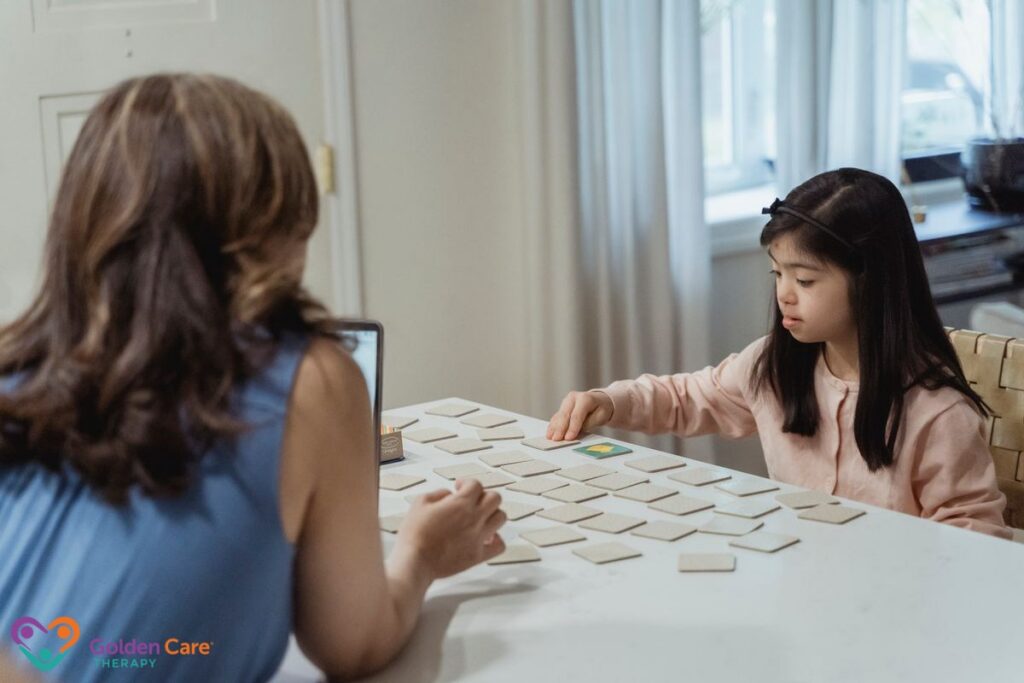
- Play-based sessions: A therapist might use bubbles, toy cars, or puppets to spark language. For example, a child who points at bubbles may be prompted to say “pop.”
- Modeling words: If a child says “car,” the therapist expands it to “big car” or “red car.” This builds vocabulary step by step.
- Visual supports: Pictures or flashcards help link objects with words.
One study from the Journal of Autism and Developmental Disorders found that children receiving consistent speech therapy improved expressive language by up to 70% over one year. That’s proof of progress.
So, is autism speech therapy a magic switch? Not exactly. But with time, it creates pathways that help children find their rhythm in communication.
ABA Therapy in Indiana and ABA Therapy in New York: Why Location Matters
Why does geography matter in autism services? Because access can shape progress.
In Indiana, families often turn to the Applied Behavior Center for Autism. The state has a strong network of providers offering applied behavior analysis therapy, which is widely used for communication support.
Meanwhile, New York has one of the largest autism support communities in the U.S. Families here benefit from urban centers filled with ABA specialists, speech therapists, and developmental programs. The density of providers makes scheduling and consistency easier.
Whether it’s ABA therapy in New Jersey or ABA therapy in Georgia, the key isn’t just access. It’s finding a program that tailors strategies to your child’s needs.
ABA Therapy at Home: Exercises for Speech Delay Issues
What happens when therapy comes home? More practice. More comfort. More chances to grow.
Here are a few simple autism communication strategies used in ABA therapy at home:
Get silly to spark imitation
Kids love playfulness! Making silly faces, blowing raspberries, or mooing like a cow encourages them to copy you. Example: Try making funny sounds while brushing teeth together in front of a mirror.
Cut down on screens for more creativity
Screens and noisy toys grab attention, but they don’t always promote language. Example: Instead of pressing the fire truck button, remove the batteries and encourage your child to make the “siren” sound themselves.
Introduce simple sign language
Gestures like “more,” “help,” or “all done” provide a bridge to words. Example: Guide their hands through the sign for “open” before handing them a snack pack.
Encourage asking through choices
Offering two options motivates communication. Example: Hold out crackers and carrots, then wait for them to point or say “cracker.” Follow up with praise.
Build phrases step by step
Expand single words into simple phrases. Example: If your child says “drink,” model back with “more drink.”
Label objects in daily routines
Point to items like “cup,” “ball,” or “shoes” while naming them aloud. Example: Hand over a cup while clearly saying, “Cup! ”
Play echo games
Say “ma” or “ba” and wait for your child to copy. Example: Celebrate with claps or a hug when they try.
Narrate their actions
Describe what’s happening in real time. Example: If they’re stacking blocks, say, “Stack blocks.” Tall tower! ”
Celebrate every success
Whether it’s a gesture, sound, or word, respond with excitement. Example: “Yes! You said juice! Great job! ”
Everyday life becomes a classroom when therapy comes home—giving kids more chances to grow while parents become co-teachers.
Why Autism Communication Strategies Work

Children with autism process the world differently. Words may take longer to connect. But strategies bridge the gap.
Effective approaches include:
- Imitating your child’s sounds and play to spark turn-taking.
- Simplifying speech into one- or two-word phrases.
- Using pauses—giving children time to respond instead of rushing in.
- Following their interests—if your child loves trains, use train play to model words like “go” or “track.”
A study in Pediatrics showed that children with consistent language interventions made significant improvements in functional communication within six months. That means small daily actions truly compound.
Four Effective Communication Tools Counselors Can Use with Children on the Spectrum
When it comes to supporting children with autism, communication is often the biggest hurdle. Counselors and therapists need flexible strategies that can adapt to different abilities and preferences. Some methods are simple, others rely on technology—but all share the goal of helping children find their voice. Here are four approaches often used in therapy.
Communication boards are a practical starting point. Children point to pictures, words, or symbols to share what they want or feel. Boards can be as basic as laminated charts or as advanced as electronic devices.
Picture Exchange Communication System (PECS) takes visuals a step further. Instead of just pointing, children hand over a picture card in exchange for an item or activity. This structured exchange teaches the power of communication and prepares some children for more advanced tools.
Speech-Generating Devices (SGDs) give children the ability to produce spoken words by pressing icons or typing letters. These devices are powerful for promoting independence but may come with high costs.
Sign language remains another valuable option. For children with the motor ability to use it, American Sign Language (ASL) offers a rich and expressive way to communicate while also connecting them to a broader community.
Ultimately, no single strategy works for every child. Counselors must weigh accessibility, ease of use, and each child’s strengths to create a communication plan that truly empowers.
Three Behavioral Approaches That Help Children with Autism Thrive
While tools like PECS or speech devices support communication, many children on the spectrum also benefit from therapies that address behavior. These approaches build confidence, reduce stress, and create stronger pathways for learning and social interaction. Here are three strategies commonly used in autism support.
Applied Behavior Analysis (ABA) is the most widely practiced method. By rewarding positive behaviors and ignoring disruptive ones, ABA helps children build practical skills for home, school, and social settings. Sessions often run 20 to 40 hours per week, providing consistent opportunities to practice. Parents can also reinforce strategies at home, making ABA one of the most flexible and structured options.
Relationship Development Intervention (RDI) takes a social-first approach. It emphasizes skills like eye contact, turn-taking, and reading body language. Families play an active role, working with therapists to set goals and support progress through everyday activities. This method fosters stronger bonds and helps children connect more meaningfully with others.
Sensory integration therapy addresses sensitivities that can overwhelm children with autism, such as bright lights, loud sounds, or certain textures. Therapists introduce sensory input gradually, helping children become more comfortable in environments like classrooms or playgrounds.
Together, these approaches complement communication strategies, giving children well-rounded support for growth, independence, and connection.
Autism Language Development: Building on Strengths
Autism doesn’t erase a child’s ability to learn language. It reshapes the journey.
Some children may:
- Use unique phrases.
- Speak with a flat tone.
- Prefer written words over spoken.
Others thrive with devices like tablets that “speak” when buttons are pressed. These tools don’t replace speech—they often encourage it.
A 2018 study found that children using augmentative and alternative communication devices improved spontaneous speech over time. Isn’t that powerful? It proves there’s more than one path to finding a voice.
Table: Key Strategies for Autism Communication
| Strategy | How It Helps | Example Use Case |
| Visual Supports | Builds word-object connections | Picture cards for “eat” and “play” |
| Echo Imitation | Strengthens sound patterns | Parent says “ba,” child repeats |
| Simplified Language | Eases processing | Say “cup” instead of “drink cup.” |
| Play-Based Interaction | Makes learning fun | Blowing bubbles and saying “pop” |
| ABA Reinforcement | Encourages attempts | Reward saying “ball” with play |
| The Role of Families | Therapists guide. Families amplify. | Active family involvement in practice at home |
Parents who model words, celebrate small wins, and stay patient see stronger outcomes. Even five minutes of daily practice—like singing songs or labeling toys—can spark progress.
As one parent shared in Autism Parenting Magazine, her son went from pointing at juice to saying “juice please” within months. The secret? Repetition and encouragement at home.
FAQs
1. Can children with autism who are nonverbal ever start talking later in life?
Yes. Research shows many children considered nonverbal at age 4 eventually develop language skills. Growth can happen at any stage.
2. Is autism speech therapy only for young children?
Not at all. Teens and even adults benefit. Therapy adapts to each age and stage of development.
3. What role do siblings play in autism communication progress?
Siblings often become natural practice partners. Games, playtime, and casual talk encourage speech in safe, familiar settings.
4. Are apps and devices replacing speech therapy?
No. Devices support therapy, but human interaction remains the foundation of progress. Technology is a tool, not a replacement.
5. What if my child only uses gestures or one word at a time?
That’s still communication. With guidance, those small steps can expand into phrases, sentences, or alternative systems that work for your child.
Building Connections That Last a Lifetime
So, what’s the takeaway? Every child with autism has the ability to communicate—it just looks different for each one. Some children use words, while others rely on gestures, pictures, or devices. The goal is to create pathways that match their strengths and bring families closer together.
With the right support, from autism speech therapy to ABA therapy near me, progress is always possible. Families in New York and beyond now have more tools than ever to help children grow their voices. And remember, progress doesn’t always come in full sentences—it might be a small sound, a new sign, or even an eager glance.At Golden Care, we celebrate each step because communication is about connection, not perfection. If you’re ready to explore how personalized strategies can help your child thrive, reach out to Golden Care today and discover support that truly makes a difference.